


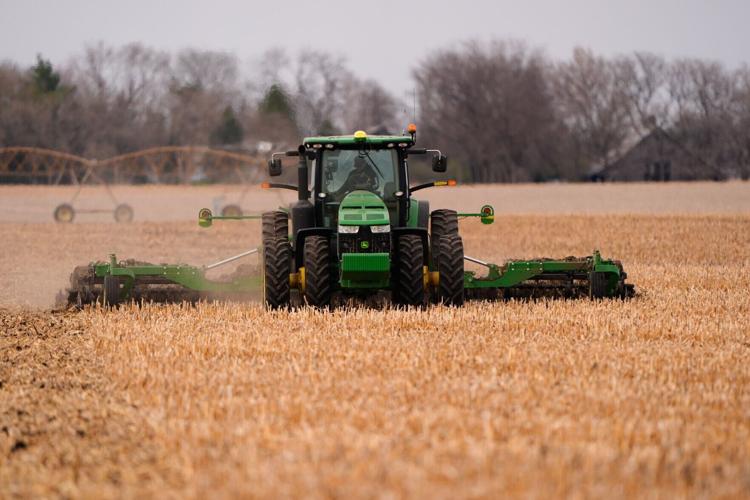

Farmers are getting hit by higher costs for fertilizers and fuel due to the increase in prices stemming from the U.S./Israel war with Iran and closures of the Strait of Hormuz.
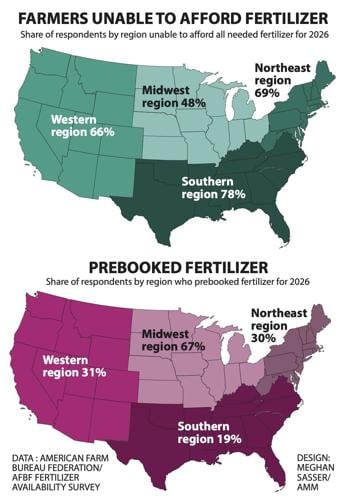
Seventy percent of American farmers say they cannot afford all the fertilizers they need for their fields and crops.
That is according to a new survey by the American Farm Bureau Federation.
The survey shows that more than three-quarters (78%) of farmers in the southern U.S. and two-thirds or more in the West (66%) and Northeast (69%) say they can’t afford higher-priced fertilizers.
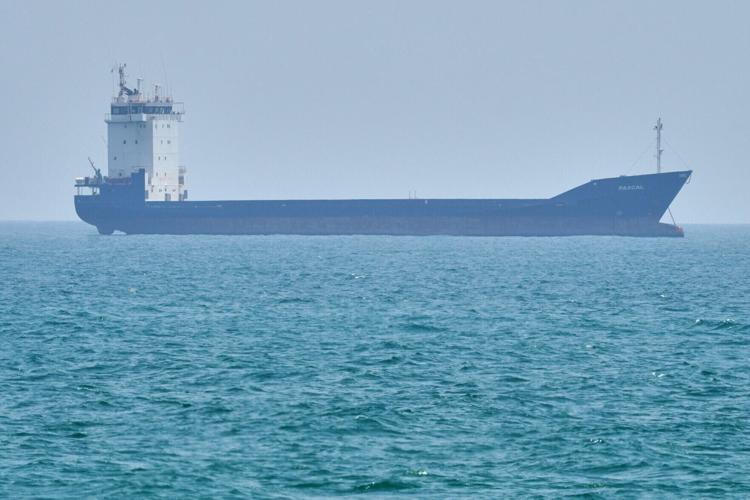
The Persian Gulf strait carries 20% of the world’s oil flows and as much as 30% of the fertilizer exports, according to the Center for Strategic and International Studies.
The war has pushed diesel prices up 46% for farmers and seen fertilizer costs increase by as much as 47%, according to an analysis by Farm Bureau Economist Faith Parum.
Diesel prices averaged $5.49 per gallon nationally on Wednesday, according to AAA’s Fuel Gauge Report. Gasoline prices stand at $4.02 per gallon, up from $2.98 before the war started at the end of February.
‘DOWNSTREAM RISKS’“Right now, farmers are managing rising costs on two fronts — fertilizer and fuel — both of which are critical inputs for planting, growing and harvesting a crop,” said Hunter Swisher, CEO of Phosphosolutions, a Pennsylvania-based company which develops more sustainable fertilizers.
“We’re hearing directly from growers who can’t access or afford all the fertilizer they need, resulting in delayed applications, reduced rates, and in some cases, the choice not to apply certain nutrients, including phosphorus, this season to manage input expenses,” Swisher said.
Washington-based International Food Policy Research Institute said in an analysis earlier this month that higher fertilizer prices and constrained flows could result in reduced soil applications and crop yields, subsequently decreasing global food supplies.
“Fertilizer represents one of the biggest downstream risks. Roughly one-third of global fertilizer trade transits the Strait of Hormuz, including large volumes of nitrogen exports,” said David Fairnie, a Scotland-based supply chain consultant with BSI Consulting.
The U.S. and Iran continue to negotiate an end to the war and reopening of the Strait of Hormuz.
U.S. President Donald Trump announced Tuesday that he was extending the ceasefire but was keeping an American naval blockade of Iranian ports and Iranian approved ships in place in the strait. Iran has also restrained cargo ship movements.
All that leaves oil, fertilizer and other cargo flows constrained.
‘AT THE MERCY’On Friday, U.S. Secretary of War Pete Hegseth said the war and blockade had reduced Iran’s military to a “gang of pirates with a flag.” Hegseth said Trump has ordered more crackdowns on Iranian small boats impeding cargo flows in the Hormuz Strait.
But even if a peace deal is struck and the Hormuz Strait is reopened, it will take some time for fuel and fertilizer prices to ease.
“Unfortunately, prices won’t fall as quickly as they rose. It takes time for operations to return to a state of normalcy, so we’re at the mercy of transport and supply chains stabilizing, which takes time,” said Jesus Davis, senior vice president for energy services at Industrial Info Resources, a Texas-based energy and industrial research firm.
Davis said fuel prices will fall faster than fertilizers once the war is resolved.
It will also take time to repair and rebuild damaged infrastructure from the war, see shipping insurance premiums ease, and watch ports and supply chains return to normal flows.
Arif Gasilov, a partner with Gasilov Group Inc., an Arizona-based environmental consulting firm, said fertilizer prices could take six to nine months and diesel prices four to six weeks to return to pre-war levels.
“Fertilizer is slower because it depends on natural gas feedstock prices, production restart timelines and shipping logistics that are all still disrupted,” Gasilov said, also pointing to infrastructure damage from the war.
“Fertilizer infrastructure in the Gulf region took damage, and rebuilding supply chains for bulk commodity inputs takes months, not weeks,” he said.
Trump and Israeli Prime Minister Benjamin Netanyahu contend the war is needed to stop Iran from developing nuclear weapons and end Tehran’s support for militant proxy groups.
Trump says the U.S. blockade is strangling the Islamist regime in Tehran. “Iran is collapsing financially,” Trump said in a social media statement Wednesday.
‘ON NOTICE’At home, farmers are feeling pinched: 58% said their financial conditions are worse than a year ago, according to the Farm Bureau survey of 5,700 farmers conducted earlier this month. Six percent of farmers surveyed said their finances are getting better, while 36% say their situations are similar to 2025.
Portions of the U.S. — including portions of Florida, North Carolina, Idaho, Wyoming, Texas, Georgia and Utah — are also dealing with increasing drought conditions.
Trump and U.S. Agriculture Secretary Brooke Rollins have both warned fertilizer sellers not to gouge farmers and other customers.
“We are putting fertilizer companies on notice — don’t use the Iran conflict to exploit our American farmers. President Trump has farmers’ backs and will not put them in the crosshairs of bad actors,” Rollins said in a statement to Adams MultiMedia.
A U.S. Department of Agriculture (USDA) spokesperson touted Trump-backed tax cuts in last year’s One Big Beautiful Bill as helping growers and said the administration has allocated $30 billion to farmers since 2025.
The USDA announced $12 billion in one-time Farmer Bridge Payments in December. The federal financial aid aims to help farmers who have faced disruptions and financial strains from post-pandemic inflation and Trump’s tariffs.
Some of those tariffs have been invalidated by the U.S. Supreme Court, but Trump still has other tariff powers.
In March, Trump also issued a 60-day waiver for the Jones Act allowing foreign ships to carry cargo between U.S. ports.
The federal government and a number of states have also lifted summer seasonal restrictions on ethanol sales to help ease gasoline prices.
EARLY ORDERSSome farmers had ordered fertilizers before the price shocks that began with the war on Feb. 28
However, the Farm Bureau survey shows disparities in pre-war fertilizer bookings ranging from 67% of farmers in the Midwest to 19% in the South.
The situation is prompting some operational mitigations among agricultural producers.
“What’s notable is that this isn’t just a pricing story; it’s actively shaping behavior in the field,” Swisher said.
He said farmers are looking at how to apply fertilizers more efficiently.
“We’re hearing from growers who are prioritizing approaches that help them capture more of the nutrients they apply to maintain productivity with fewer inputs,” Swisher said.
Gasilov said some farmers are switching from corn to soybeans because the latter requires less nitrogen and fertilization.
Others are reducing soil applications, which could impact future crops, Gasilov said.
“Cutting fertilizer application is borrowing against next year’s soil health, and switching crops mid-season limits what you can plant,” he said.
‘E
NERGY INTENSIVE’
According to agriculture analysts, moving away from fertilizers can reduce crop yields.
“Coffee growers in Ghana stopped using fertilizer and saw their production decrease by 75%. American farmers are likely looking at similar impacts if they don’t use fertilizer,” said Tim J. Smith, founder and CEO of Wiglaf Pricing (a Chicago-based business consulting firm) and an adjunct economics professor at DePaul University,
“Just examine the productivity difference between conventional and organic farming. Conventional farming is two to three times more productive than organic farming,” Smith said.
The upward cost pressures can be seen up and down the food chain — from farm to table.
Smith said herbicides, fungicides and pesticides are also derived from oil and can face upward price pressures from the war and higher energy prices.
Fairnie said higher energy prices also drive up costs for food processing, refrigeration and transportation.
“It’s imperative to understand that food production is extremely energy intensive,” he said.


(0) comments
Welcome to the discussion.
Log In
Keep it Clean. Please avoid obscene, vulgar, lewd, racist or sexually-oriented language.
PLEASE TURN OFF YOUR CAPS LOCK.
Don't Threaten. Threats of harming another person will not be tolerated.
Be Truthful. Don't knowingly lie about anyone or anything.
Be Nice. No racism, sexism or any sort of -ism that is degrading to another person.
Be Proactive. Use the 'Report' link on each comment to let us know of abusive posts.
Share with Us. We'd love to hear eyewitness accounts, the history behind an article.