


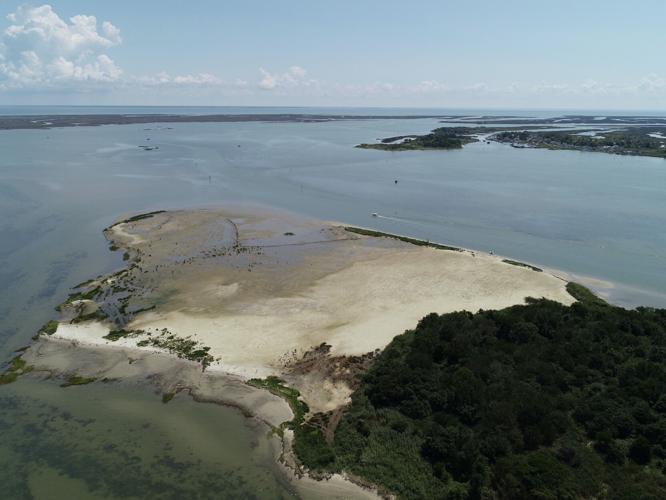
It鈥檚 August 2019 and heat radiates from the expanse of sunbaked 鈥渕ud鈥� that covers two-thirds of Swan Island, a once half-drowned 25-acre island at the southern edge of Martin National Wildlife Refuge in the Chesapeake Bay.
The western third of the island, which is part of the archipelago that includes Maryland鈥檚 Smith Island, is a forested hummock known as the 鈥渞ookery.鈥� The newly placed mud (sediment, strictly speaking, which is a mixture of mud and sand) is about a foot deep and slopes gradually from high to low elevation, west to east. Marsh plants, some 200,000 of them, small and struggling in the summer heat, reach across the otherwise barren landscape in parallel rows.
Months earlier, this sediment was at the bottom of a nearby shipping channel 鈥� then dredged by the U.S. Army Corps of Engineers and spread on the island in an effort to restore it. It was enough dredge material to fill 18 Olympic size swimming pools.
In the past, sediment was considered an unwanted byproduct of routine dredging 鈥� scraped from the bottom of channels to keep them deep enough for ships. Until fairly recently, the common practice was to dispose of the dredge material upland and offshore, effectively removing sediment from the system. Now sediment is a prized resource in efforts to restore drowning Bay islands.
Given what we are up against, with climate change multiplying threats, we need to think beyond concrete and rebar, beyond even single-habitat restoration. We need to adopt a 鈥渕ultiple lines of defense鈥� strategy to take advantage of the resilience potential of nature. Multiple habitats like islands, wetlands and reefs provide more protective benefits from storm and non-storm conditions than a single habitat type
Sediment is the key to sustainability for these low-lying ecosystems. Plants have a natural 鈥渂affling鈥� effect 鈥� slowing the flow of water 鈥� which allows sediment to drop out of suspension and settle on the bottom, where the plants trap and stabilize it. This is how natural systems like islands, mangroves, and marshes build elevation. But this can鈥檛 happen without enough sediment to outpace sea level rise. Plants drown when water rises and there is not enough sediment for them to build elevation.
Islands are the mainland鈥檚 first line of defense from the Bay鈥檚 waves, reducing erosion and flood risks to communities and shorelines. But those defenses are wearing thin, quite literally. Erosion and land subsidence (sinking land) have done their work for millennia, and rising seas have sped up the process.
Poplar (before restoration), Barren, James, Tangier and other islands have dissolved to slivers of their former selves. In a 15-year period alone (early 1990s to mid-2000s), islands in Tangier Sound lost 21% of their land to erosion from repeated dune and vegetation washovers. This has caused precipitous declines in waterbird nesting.
Islands are a lifeline for struggling bird populations. 鈥淟oss of habitat is driving waterbird declines throughout the Bay,鈥� said Matt Whitbeck, a wildlife biologist with Chesapeake Marshlands National Wildlife Refuge Complex. 鈥淚slands are especially important for birds because they can provide predator-free nesting habitat.鈥�
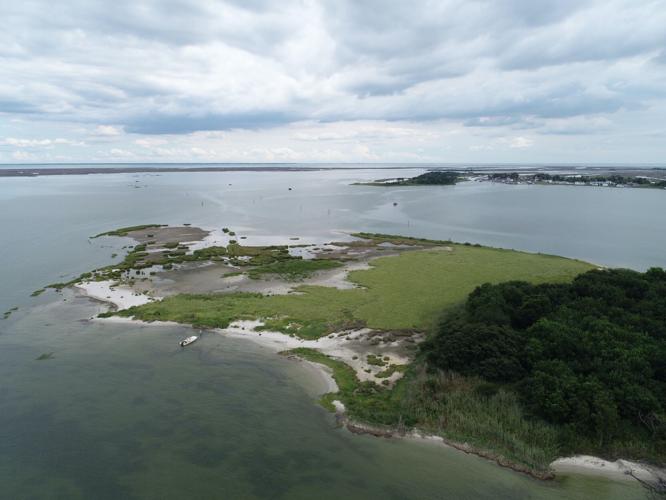
By August 2022, the once mud-caked eastern third of Swan Island had become a lush waist-high meadow of high marsh sloping toward lower elevations, where patches of 6-foot-high marsh grass push outward into a mosaic of intertidal pools and mud flats 鈥� now home to skulking egrets and grandstanding fiddler crabs brandishing claws. Sediment trapped by robust low-marsh thickets forms elevated micro-dunes where dune grasses begin to take root. Semipalmated plovers and sanderlings scurry, heads low, across the pockmarked mud flat and through shallow pools in search of their next meal.
While the 鈥渆levation capital鈥� has increased and bought the island more time, the erosional trend is clear. Without action 鈥� i.e., some kind of intervention to slow erosion, facilitate accretion or add sediment 鈥� Swan Island鈥檚 days are numbered.
This story is playing out all over the Chesapeake. Starting in 1984 with Hart-Miller Island near Baltimore, the Corps of Engineers has used dredged sediment for the restoration of Battery Island, near Havre de Grace in the upper Bay; Poplar Island, near Tilghman; and parts of Barren Island, off upper Hooper Island in the middle Bay. After Poplar鈥檚 completion, Barren and nearby James Island will receive sediment from the Port of Baltimore.
Danielle Szimanski, a project manager with the Corps鈥� Baltimore District, has been helping to build islands for the last seven years. 鈥淭he beneficial use of sediment from routine channel maintenance can slow island loss, keep sediment in the system and provide multipurpose benefits,鈥� she said. 鈥淎nd, given all the remnants out there, I hope to continue restoring islands.鈥�
Fortunately, momentum is building for beneficial-use and island restoration. With this strategy we can capitalize on the resilience power of nature and go beyond the single-minded use of conventional reinforced concrete. With its Engineering With Nature initiative, the Corps of Engineers has embraced natural approaches and a multiple-lines-of-defense strategy.
We need to embrace those ideas, too, and develop a new vision of what coastal resilience looks like.
Paula Whitfield is a research ecologist, recently retired from the National Oceanic and Atmospheric Administration. Her views do not necessarily reflect those of the Bay Journal. This article first appeared in the May 2023 issue of the Bay Journal and was distributed by the Bay Journal 九色视频 Service.


(0) comments
Welcome to the discussion.
Log In
Keep it Clean. Please avoid obscene, vulgar, lewd, racist or sexually-oriented language.
PLEASE TURN OFF YOUR CAPS LOCK.
Don't Threaten. Threats of harming another person will not be tolerated.
Be Truthful. Don't knowingly lie about anyone or anything.
Be Nice. No racism, sexism or any sort of -ism that is degrading to another person.
Be Proactive. Use the 'Report' link on each comment to let us know of abusive posts.
Share with Us. We'd love to hear eyewitness accounts, the history behind an article.